Redacted
Sometimes, to fulfill the creative vision you have, you need a certain energy. And if the energy you need is explosive, it helps to know people.
Written by Aaron Berger
Having worked with Cody on a multitude of projects in the past, I’ve gotten a good sense of how he creates. So when I heard that he was planning on working on a piece around hand-crafted violins, I initially offered up a lens set for consideration, as I thought it would match his creative vision. But after talking with him about how he wanted the project to feel, I wanted to do much more than just lend some extra equipment.
The planning stages, I’d argue, ate up the most time. That effort wasn’t wasted, however, as the storyboards produced from it really helped develop the depth needed to find the right theme. After having multiple conversations about color, the cameras to be used, and the crew that would be on set, I could truly see the vision. I think everyone else could, too, because I’ve never seen so many people come together, volunteering their time and equipment to make this project happen without the need for investors.
On the day of the shoot, rain and gloom brought quickness to the steps of everyone loading gear into the building. Inside, the skill of everyone was beyond what I could have expected. An example of this was the handling of the lens set I had brought for use. As Cody put it, “Jeremy would hand you lenses so well that I would want him to keep them by the end of the day.” This expertise cleared all worry that might have kept me distracted and allowed me to focus on my role on set. Audio.
In the past, I have done a number of gigs as a location sound recordist, so the plan was for me to fulfill that role, focusing mainly on the ambient noise of the Luthier at work on his craft. Interestingly, the head of audio post-production, Lucas Hibdon, was on set. Unsurprisingly, like everyone else, Lucas was an expert, there to make sure all of his post-production sound needs were recorded authentically. Lucas was very on top of what he wanted to have captured, so much so that I rigged him up with the mixer and became purely the boom operator. Since the sound being recorded was all in a similar range of loudness, I set the gain for Lucas and let him simply control the fader on the boom. Getting the coverage needed by following the nonverbal cues for the rest of the day was so smooth that I felt like I had been working with Lucas for years. There really is some serious magic that happens when the crew you are working with just slots together like perfectly fitted puzzle pieces.
One of the most impressive shots we recorded that day had to have been the dolly zoom, light gag, spin shot. (And yes, it is just as complicated as it sounds!) The final shot of this movement can be seen in the film at the two-minute mark. To start off this shot, the Luthier was seated on a spinning stool in the center of his shop’s small concert hall and was instructed to spin on the chair while bringing up the violin to be played. The next layer was to have the camera op dolly the A-cam out and zoom in while the focus puller racked. The final step was to do an active light change while the Luthier was spinning: taking the lighting from an off-axis softbox lighting the scene to a pure background spotlight, silhouetting the subject. This, in combination with the music swell into the next shots, gives a true feeling of being “taken to another planet.” What is interesting is that the most impressive shot I saw on set is followed by one of the most fun shots I’ve gotten to help create: exploding a violin. Since we are breaking down shots, let me tell you how this came to be.
Growing up in a family of hunters and artists really makes for an interesting blend of life skills you learn. It certainly helped me when it came to getting jobs capturing remote hunts in the Rocky Mountains and tactical sniper schools. And I knew that Cody had a good idea of the people I’d interacted with and gotten to know. So when he made comments after wrapping the shoot days with the Luthier about wanting more shots with “broken violins,” I kept a mental note of this. Lo and behold, when a phone call came in two weeks after we had our debrief call, it was easy to know exactly where the call was going.
“Hey, Aaron, so I got ahold of a couple of broken violins, and I have a couple of shots I really want to add to the piece. There is this really clear vision I have in my head of what I want to do, and I think you’d be able to help me. I am thinking of renting a super slow-mo cam like a Phantom…”
“Cody, are you asking me to blow up some violins for you?”
“I am asking you to blow up some freaking violins!”
Getting to work immediately, I reached out to to help me. With his expertise in improvised explosives from his service in Iraq, his active service on a bomb squad, and, most importantly, his licensing to work with explosive substances, I knew he was the man to help. After some discussion, we quickly ruled out any true “Hollywood” pyrotechnics, as they would not provide the energy needed to turn a violin into a pile of scrap wood. What we needed was something that would deliver a sharp spike of energy. The conversation ended with going to look into options for me.
The next steps I needed to take were to find a location and make sure we could record the explosion safely. The first of these was easy enough to solve. As before, I knew someone who had a location deep in Illinois farmland with a deep-gully shooting range on private land. But it was the safety portion that I was most concerned about. Less from the explosion, more from the shrapnel. The thing that should be understood is that shrapnel acts like a hurricane, lightning, or a tornado. There are predictable portions and portions that are the wildest of curveballs. The easy portion is to just math out the force of an explosive and go significantly past the minimum safe distance. However, we needed to be close enough for the camera to record. But to figure that out, first we’d need to get the full specs of the explosives.
That talk took a lot of back-and-forth with my contact, as well as testing a couple of options. But in the end, what we settled on was a <SUPER REDACTED!>.
Well, to keep this from looking like a Call of Duty: Black Ops cutscene, let’s just say . . . we found that the most legal version, which required the least amount of paperwork to make happen and was the cheapest, was the best choice. With that out of the way, the minimum safe distance was 25 yards and, with potential shrapnel, 50 yards. So I planned to make the setup happen between 75 and 100 yards away for recording, with additional blast shields to be built. I ended up going over the math several more times with my contact to ensure safety was at 100%, and then even more, right up until the day of the recording.
Unfortunately, we were also working against the weather that day, as the forecast called for rain in the afternoon. So we arrived at the gully range location early with ½-inch-thick plywood boards and ¼-inch-thick impact-resistant plexiglass. I got to work with Cody building the barricades, then building out the rented FREEFLY Wave high-speed camera with my monitor and battery setup. The focus plane of the 400mm lens was incredibly thin, even stopped down. We did our best to accurately set focus, as the lens had an EF mount adapted for the native Sony E-mount of the FREEFLY. Then I unpacked the sniper rifle and set it up. This was the method of detonation chosen for multiple reasons. I then set up the second shield for the rifle position, slightly separated but at an equal distance from the camera’s redundant protection. I went over my safety briefing with Cody. Then it was time.
There were three violins to evaporate, all too damaged to repair.
My heart rate was notably elevated.
I took my place behind the rifle, Cody behind the camera.
“3!…”
I inhaled.
“2!…”
Emptied my lungs.
“1!…”
Steadied my aim.
“Speeding!”
And squeezed the trigger.
The dissipated concussive wave that washed over us was nothing new, but the cheer from Cody as he cut the camera was a good sign. I cleared the rifle, put all the proper safeties in place, and took a look around. The violin had effectively vanished, and nothing had reached the shields. No one was hurt. No unintended damage. Everything was good. That feeling upgraded to great when we started reviewing the footage. It was the closest I’ve ever felt to being a MythBuster, and the successful combination of science and technology was beautiful to see at 1,461 frames per second. After reviewing the footage, we made a couple more tweaks for the second violin, and the same process was repeated for the third. We had three very unique clips of explosions, and working within the limitations of what we could afford, I was very impressed with what we were able to capture. Checking the area to make sure no fires had started from any of the debris, I was glad we had taken the extra steps for safety, as I found one large chunk of violin sitting 10 yards from us.
Before cleaning up, I brought out one secret item we were hoping to capture with the extra time we had in the day: a compact flamethrower. Because, naturally, if you have a flamethrower, you want to see it breathe fire in ultra-slow motion. The footage was so enrapturing when we reviewed it that it “sparked” something in Cody. He had to have some clips of this in the final cut. So, with what time we had left, we gathered the largest surviving chunks of violin, repositioned the Wave camera, and blew fireballs at them. The impromptu setup was so incredibly impactful to the culmination of the explosive scene. I guess it just goes to show that the gut feeling of “this would be cool” is something to be trusted, and in this case, it was part of what made the piece what it is. I’m extremely proud of that.
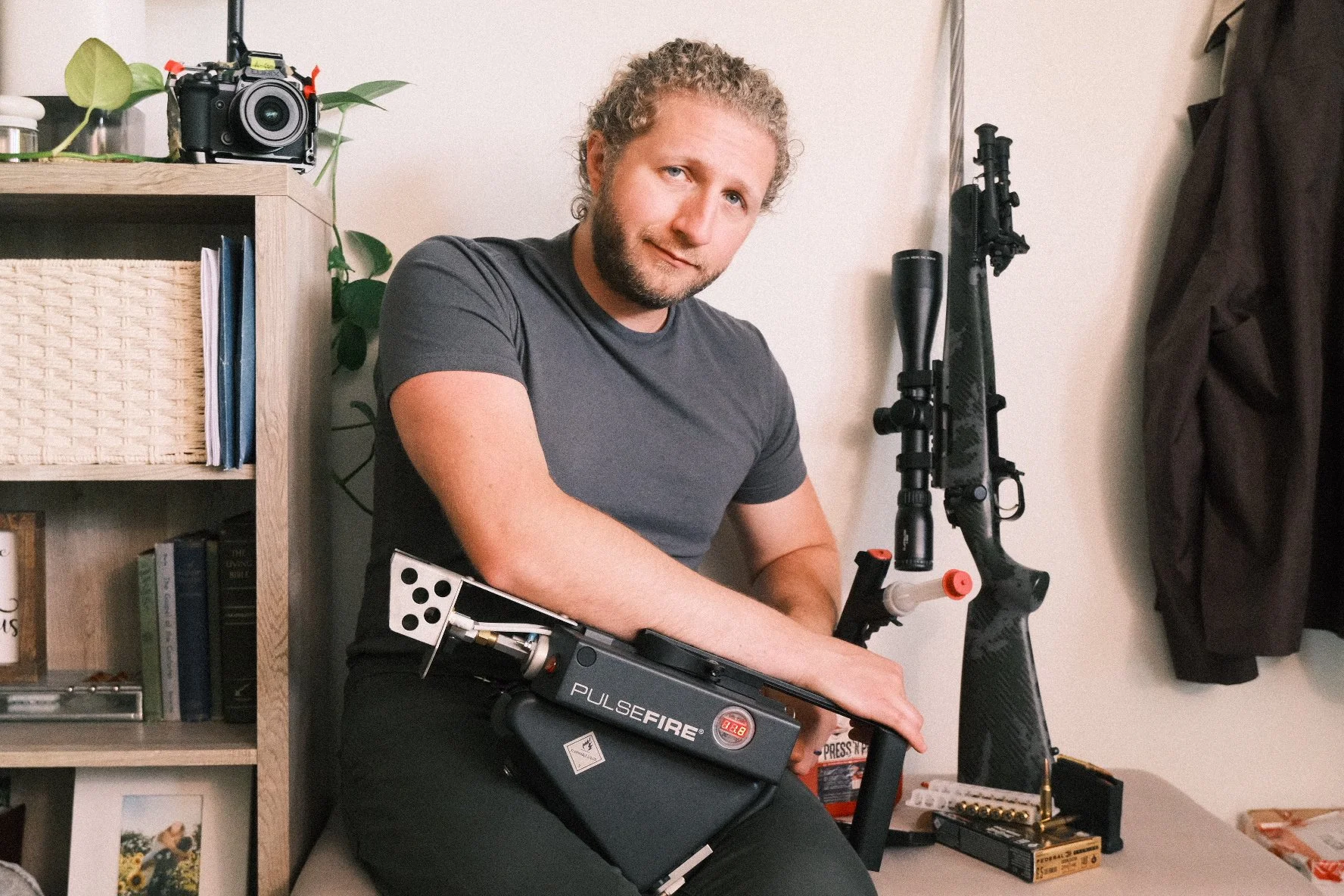
Aaron Berger self portrait